FaceTime Like a Pro
Get our exclusive Ultimate FaceTime Guide 📚 — absolutely FREE when you sign up for our newsletter below.

FaceTime Like a Pro
Get our exclusive Ultimate FaceTime Guide 📚 — absolutely FREE when you sign up for our newsletter below.


GPT-5.5 makes ChatGPT and Codex better at handling messy coding, business, and research tasks, while developers wait for API access.
OpenAI is upgrading ChatGPT and Codex to GPT-5.5, a new model built to handle longer, messier tasks with less human direction.
The company says the model has a stronger grasp of context, which improves coding, computer use, document creation, and scientific research. GPT-5.5 starts rolling out today to ChatGPT Plus, Pro, Business, and Enterprise users, as well as Codex users. GPT-5.5 Pro is limited to Pro, Business, and Enterprise.
Developers will have to wait. OpenAI says API access needs different safeguards and is not launching yet.
OpenAI is positioning GPT-5.5 as a model that can take a goal, make a plan, use tools, check its own work, and keep going when the task is unclear.
That matters because real work rarely arrives as a clean prompt. It can be a broken app, a rough spreadsheet, scattered business data, or a research question that needs several steps before the answer is useful.
In computer-use tasks, GPT-5.5 can read what is on screen, click through interfaces, type, switch between apps, and complete work such as building spreadsheets, preparing slide decks, or pulling information from raw operational data.
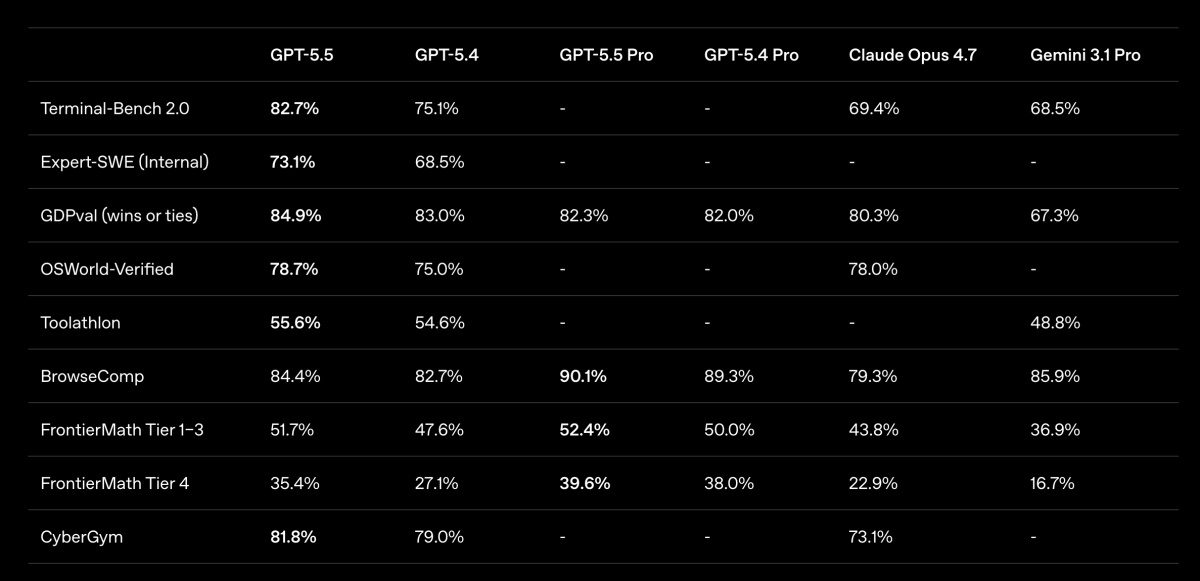
OpenAI says it already uses these abilities internally to analyze tax forms, generate weekly business reports, and build risk-assessment frameworks from communication data.
Also read: ChatGPT Images 2.0 makes AI-generated images easier to use in real work
GPT-5.5 also pushes Codex closer to an autonomous engineering assistant.
OpenAI says the model can hold context across large codebases, trace failures, test assumptions with tools, and carry fixes through connected parts of a system. That is the hard part of real engineering work, especially when one change can break another part of an app.
In internal tests, GPT-5.5 resolved real GitHub issues end-to-end in a single pass. OpenAI also says it can predict what needs testing and catch likely errors before human review.
It still needs engineering judgment around it, but the direction is clear: Codex is moving from code generation toward investigation, editing, testing, and revision with less hand-holding.
OpenAI says GPT-5.5 handles the same level of task faster than GPT-5.4 while using fewer tokens, with per-token latency staying in line with earlier models.
That efficiency matters for business use, where stronger models can become too slow or expensive at scale. OpenAI says it worked with NVIDIA on the underlying architecture and used AI to study production traffic, then improve how work is split across computing cores.
GPT-5.5 also brings gains in scientific work. OpenAI says it can run multi-stage analysis on large datasets, including genetics and quantitative biology. In one example, researchers used it to analyze nearly 28,000 genes and produce a report in minutes. OpenAI also says the model helped mathematicians find a new proof related to Ramsey numbers.
For now, the upgrade matters most inside ChatGPT and Codex. Plus users get GPT-5.5, higher-paid plans get GPT-5.5 Pro, and developers are still waiting on API access.
The larger shift is straightforward: OpenAI wants ChatGPT to spend less time giving instructions and more time completing the assignment.