
FaceTime Like a Pro
Get our exclusive Ultimate FaceTime Guide 📚 — absolutely FREE when you sign up for our newsletter below.

FaceTime Like a Pro
Get our exclusive Ultimate FaceTime Guide 📚 — absolutely FREE when you sign up for our newsletter below.


See how the M5 chip elevates Apple's silicon lineup, bringing top-tier performance to mainstream users and setting new standards in personal computing.
Apple’s new M5 chip is making headlines after early benchmarks revealed performance numbers that rival Apple’s once top-of-the-line M1 Ultra. The results mark a major leap for Apple’s baseline Mac silicon, showing just how far the company has come in just a few short years.
The first Geekbench 6 listings for the M5, found in the 14-inch MacBook Pro, show a single-core score of 4,263, the highest ever recorded for any Mac or PC processor on the platform. That puts it ahead of even the powerful M4 Max and AMD’s top desktop CPUs.
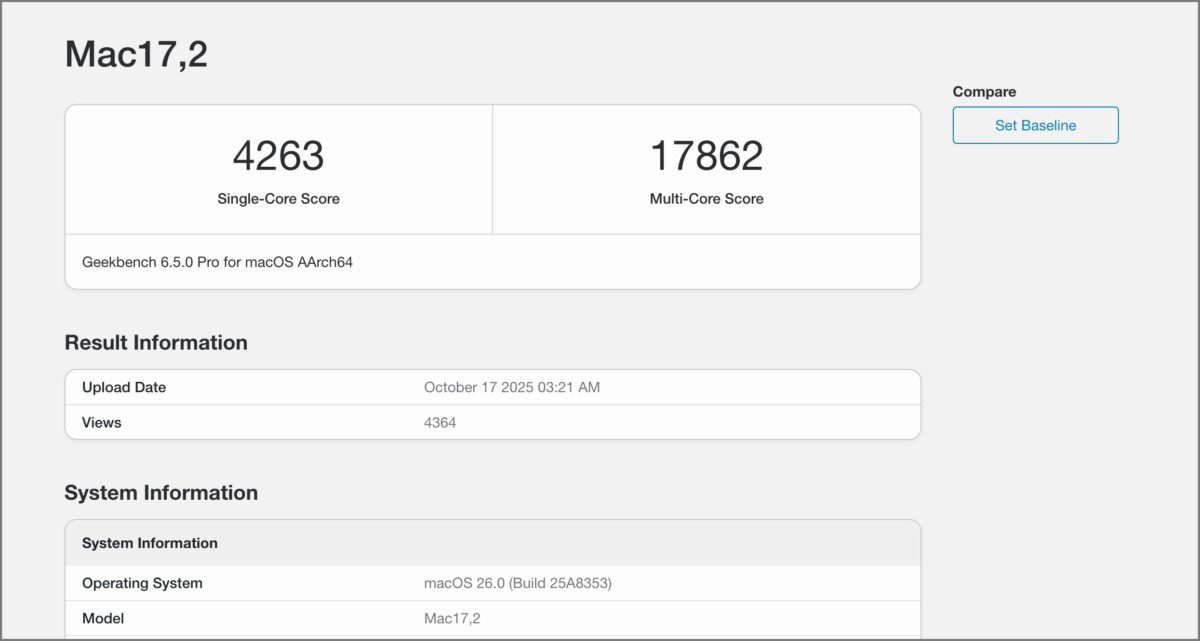
In simple terms, this score reflects how fast a single performance core runs under load. It’s the most important number for tasks like web browsing, document editing, and UI responsiveness. Apple’s dominance here reinforces how efficient its chip design has become.
Interestingly, the same M5 chip in the new iPad Pro achieved a similar single-core score of around 4,175, hinting that both Mac and iPad users can expect equally fast everyday performance.
Where things get even more impressive is in the multi-core score, where the M5 hit 17,862. That’s roughly 20% faster than the M4 in last year’s 14-inch MacBook Pro, and places it just 6% behind the M1 Ultra, which required a $4,000 Mac Studio when it launched in 2022.
For a base chip found in a $1,599 MacBook Pro, that’s remarkable. The M5 now delivers performance once reserved for high-end desktop systems, making it a game-changer for tasks like video rendering, code compilation, and heavy multitasking.
Geekbench data shows the M5 uses a 10-core CPU setup (4 performance cores + 6 efficiency cores) running at 4.61GHz, paired with 16GB of memory. In sub-tests, it leads in object detection, browser workloads, and HDR rendering—areas that benefit from both speed and sustained efficiency.
Apple’s silicon roadmap is clearly accelerating. The company is expected to release M5 Pro and M5 Max variants in early 2026, likely pushing performance even closer to workstation-class territory.
The new 14-inch MacBook Pro with the M5 chip is open for pre-orders and officially launches on Wednesday. With time, the chip will likely make its way into the MacBook Air and Mac mini, further broadening access to top-tier performance.
If these early results are any indication, Apple’s M5 marks another milestone in its journey to dominate personal computing performance—making yesterday’s ultra-premium power available to everyday users today.