FaceTime Like a Pro
Get our exclusive Ultimate FaceTime Guide 📚 — absolutely FREE when you sign up for our newsletter below.

FaceTime Like a Pro
Get our exclusive Ultimate FaceTime Guide 📚 — absolutely FREE when you sign up for our newsletter below.


Gemini just leveled up from answering your questions to understanding your life before you even ask. Learn how Personal Intelligence works!
When Google rolled out Personal Intelligence inside Gemini, I expected something like saved preferences or better recommendations. What I got instead felt closer to an AI that quietly studies you and then removes the need for you to explain yourself.
Gemini wasn’t just responding to my prompts; it was anticipating my intent, shaping answers around my habits, and quietly adapting to how I think. The shift is subtle, but once you notice it, you can’t unsee it. Here’s what Google Gemini Personal Intelligence is and how to create AI images using personal photos.
At a surface level, Google describes Personal Intelligence as Gemini, using the information on your preferences, interests, and related apps (Google Photos, Gmail, YouTube, and so forth) to come up with results tailored to you.
What I’ve experienced feels like this:
Earlier, generating something “personal” entailed creating prompts that were extremely detailed and painful to write. Now, Gemini can infer those details automatically using your connected data and history. That’s a fundamental shift.
So, now I can directly ask, “I want to replace my car tires, which ones are the perfect fit?” That’s all! Gemini pulls information and lists the options based on my needs.
Let’s break down the features the way they actually behave in real use.
This is the core engine. Gemini connects to apps like Gmail, Google Photos, YouTube, and Search, and then “connects the dots” between them to answer your queries. So, the outputs reflect your actual life, not generic assumptions.
But here’s what most people miss: It doesn’t just dump all your data into the model. It provides relevant context according to each query you make.
For example, if I ask: “Plan my next trip.”
Gemini can:
And then produce something that feels shockingly aligned with my preferences, like finding restaurants of my favorite cuisine or tourist spots I may enjoy exploring.
Google explicitly points out that Personal Intelligence removes the need for long, detailed prompts by letting Gemini “fill in the blanks” automatically.
Even when using short prompts, I’ve noticed:
Google also introduced Skills in Chrome, which lets you save Gemini prompts. So, you don’t need to repeat yourself.

Behind the scenes, Gemini AI image generator is powered by Gemini’s image model, Nano Banana 2. So, integrating it with Personal Intelligence makes the images feel biographical instead of generic outputs.
I prompted it to generate an image of my family and me in a Pixar-style scene. Gemini automatically included real people from my Google Photos and created the image based on my interests. It’s quite similar to Apple’s Image Playground, where you can choose a person to create their avatar.
Once your apps are connected, the whole process happens in the background.
There was no need to upload images or documents, repeat contexts, and switch back and forth between different apps to provide prompts. I felt like my existing digital life just became queryable and actionable.
Moreover, you can ask Gemini to summarize previous discussions, carry forward from earlier conversations, and take previous chats into account. I have shared my interests and preferences, including work, hobbies and life goals for more context.
All of this is optional and adjustable.
You can:
That control matters because, without it, this level of personalization would feel uncomfortable.
To use Personal Intelligence, you should be above 18 years old and have a personal Google account. It’s not available for Workspace Business, Enterprise or Education users. Additionally, Google has not rolled out the feature in South Korea, Australia, the European Economic Area, Switzerland, the United Kingdom, and Nigeria.
Here are the steps I followed during my testing:
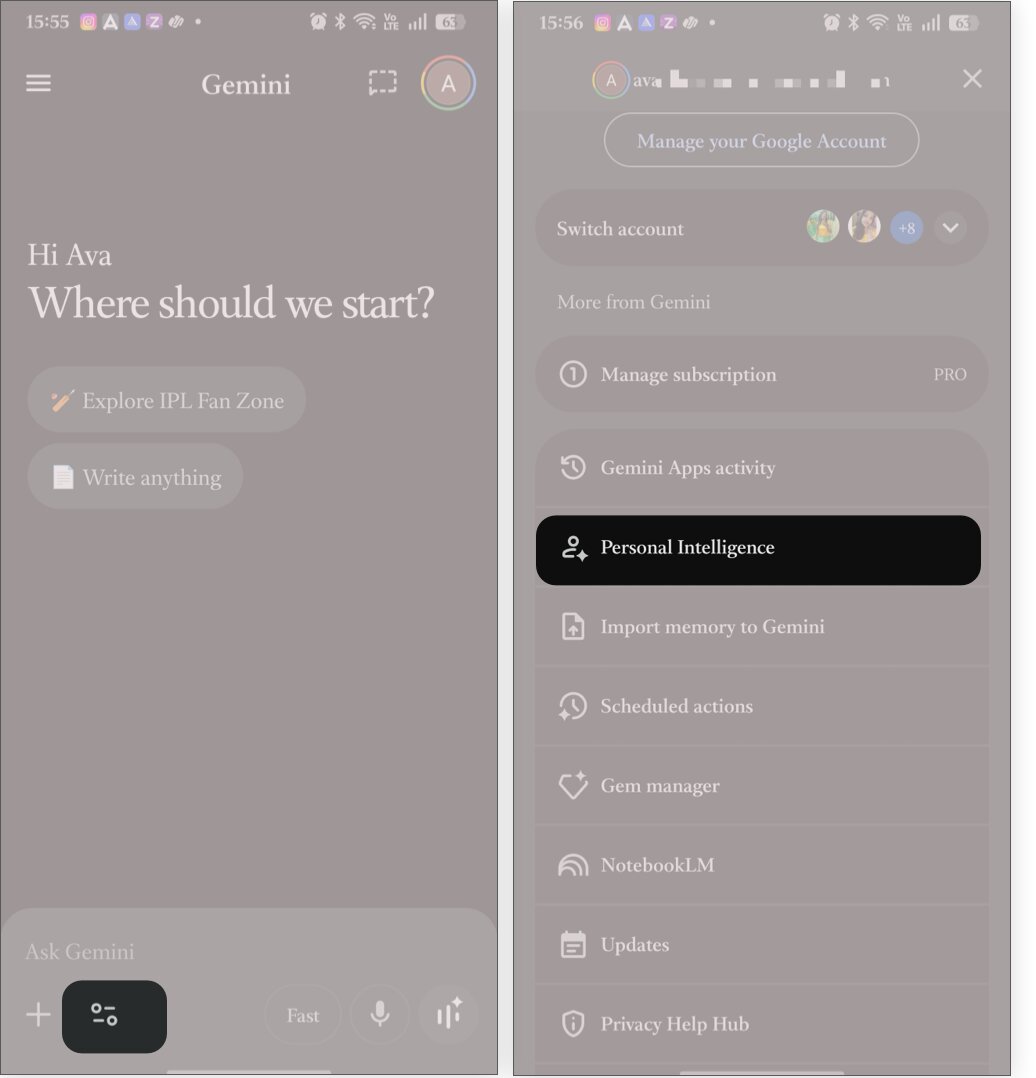
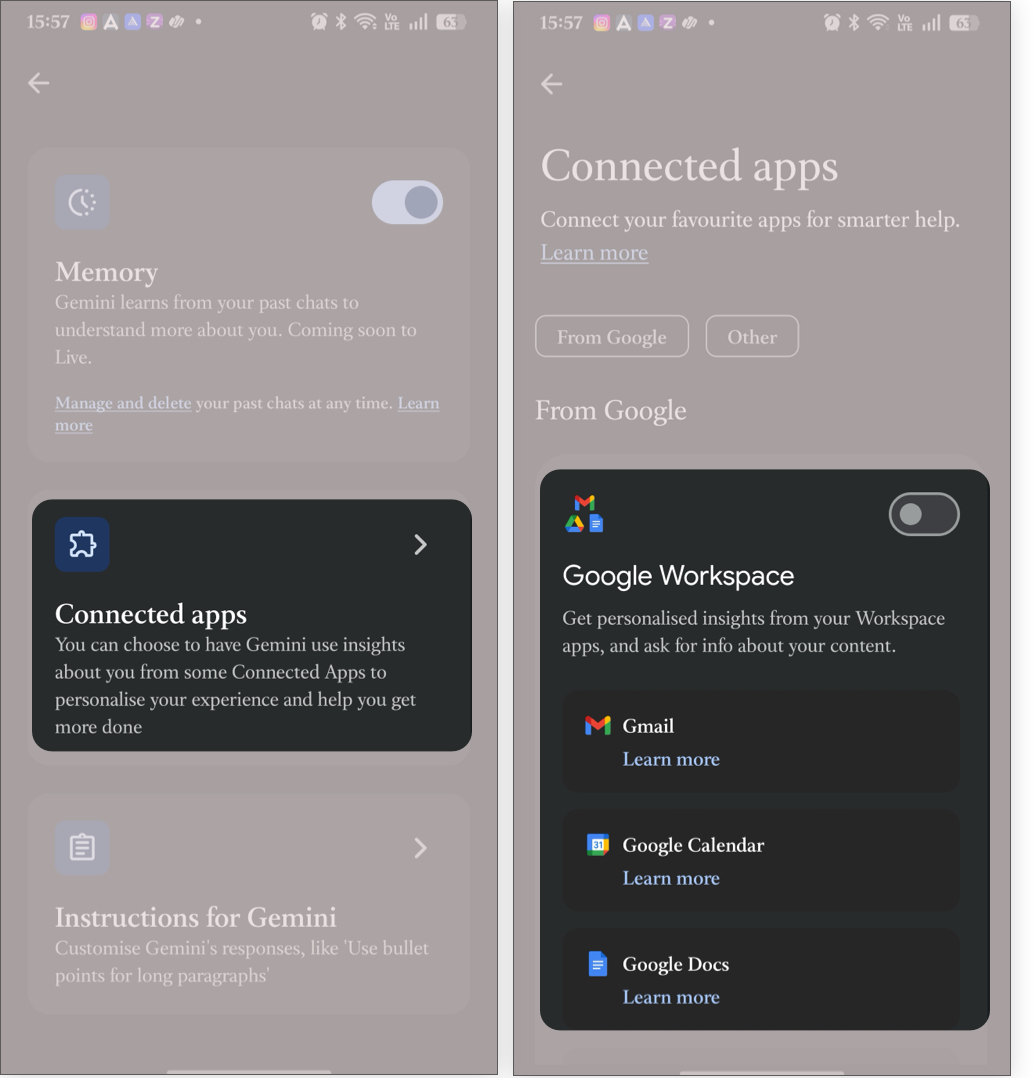
Once it’s enabled, you can access the feature across the web, Android, iOS, and macOS Gemini app. Now, based on your connections, you can ask simple prompts. For example, “Suggest a few books I might enjoy” instead of “I love horror with sci-fi touch…” You can also refine the responses without rebuilding prompts from scratch.
Note: If you can’t find the Personal Intelligence toggle, worry not. It’s still in the beta phase and may not have been rolled out in your region yet. Wait for a few days and keep the Gemini app updated.
I’ve used a lot of AI tools. Most of them impress you once and then flatten out. But Gemini doesn’t.
Because Personal Intelligence introduces something new:
Let’s not ignore the uncomfortable part.
To achieve that level of understanding, Gemini requires access to all your information, pictures, searches and behaviors, in other words, your digital footprint.
Google emphasizes that:
But while measures are taken, there’s one thing to consider: how much AI should know about you.
Because once an AI understands your preferences, predicts your intent, and shapes outputs around you, it can influence.
I went in expecting a feature. What I found was the early version of something much bigger: AI that builds a working model of you and uses it in real time.
Personal Intelligence isn’t perfect yet. It still depends heavily on connected data, and sometimes it over-assumes. But the direction is unmistakable
And that raises a question most people aren’t ready to answer yet. If your AI truly understands you, who’s shaping who?
What do you think about Gemini’s Personal Intelligence feature? Let me know in the comments below!