FaceTime Like a Pro
Get our exclusive Ultimate FaceTime Guide 📚 — absolutely FREE when you sign up for our newsletter below.

FaceTime Like a Pro
Get our exclusive Ultimate FaceTime Guide 📚 — absolutely FREE when you sign up for our newsletter below.


Confused between Spotify and YouTube Music? I compared their sound quality, features, pricing, and more.
For years, my default reflex was to open Spotify without thinking. From the gym, work, to late-night headphones, Spotify was the one I always turned to. But then, I gave myself a 30-day split test using YouTube Music to find out which one is deserving of being my go-to app.
I expected Spotify to win on autopilot. What actually happened was more interesting because Spotify isn’t just a music app anymore, and YouTube Music isn’t trying to be one in the same way. Here’s my complete Spotify vs YouTube experience, including their sound quality, pricing, and features comparison.
| Feature | Spotify | YouTube Music |
|---|---|---|
| Core Strength | Polished ecosystem | Content depth |
| UI | Best-in-class | Functional but inconsistent |
| Music discovery | Smart, highly-personalized, AI-driven | Less refined |
| Playlists | Industry-leading, smooth flow | Hit-or-miss |
| Audio Quality | Up to 320 kbps, consistent playback | Up to 256 kbps AAC, varies with source |
| Unique Content | Podcasts, audiobooks, fitness classes | Live performances, remixes, rare/unofficial tracks |
| Pricing | $10.99/month | $10.99/month (better value when bundled with YouTube Premium) |
I didn’t just casually try both apps; I lived in them.
For 30 days, I split usage across both apps during commuting, gym sessions, focused work, casual listening, and long drives. And I used the same set of headphones and switched between Wi-Fi and LTE, and actively trained both algorithms by liking songs, skipping aggressively, building playlists, and following artists.
Additionally, I used the premium tiers to get the most out of each app. By the end of week two, both apps had enough data to “understand” me. That’s when the real differences started to show.
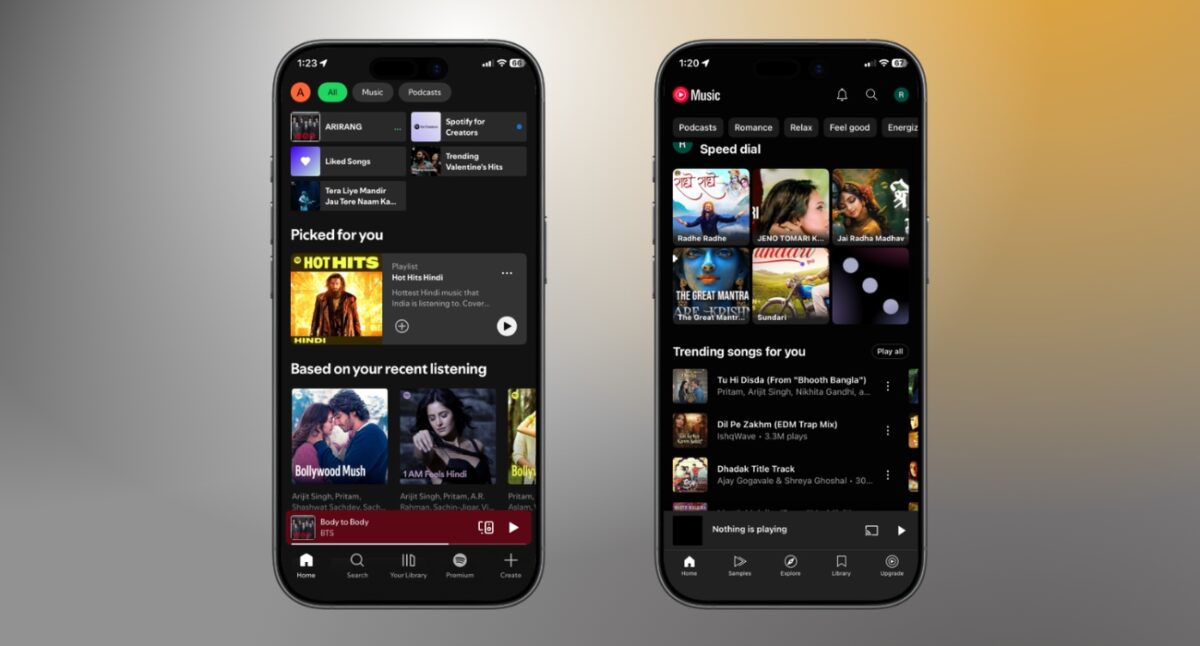
When it comes to usability, Spotify is unrivaled. It works fast and predictably. The home screen surfaces exactly what you need, like your mixes, recent listens, and playlists. Moreover, the gestures made navigation effortless, and search is fast. However, Spotify is getting crowded with music, podcasts, audiobooks, AI features, and now even fitness content.
YouTube Music, on the other hand, felt like an extension of YouTube. You can find the Quick picks, featured playlists, community mixes, and more on the home screen. The top menu has all the possible moods of music, while the bottom bar has something interesting called Samples.
As I occasionally love to watch music videos, YouTube Music wins for me as of now. Spotify has looping clips or animated cover artwork for many tracks, but it’s bringing lots of official and high-quality videos.
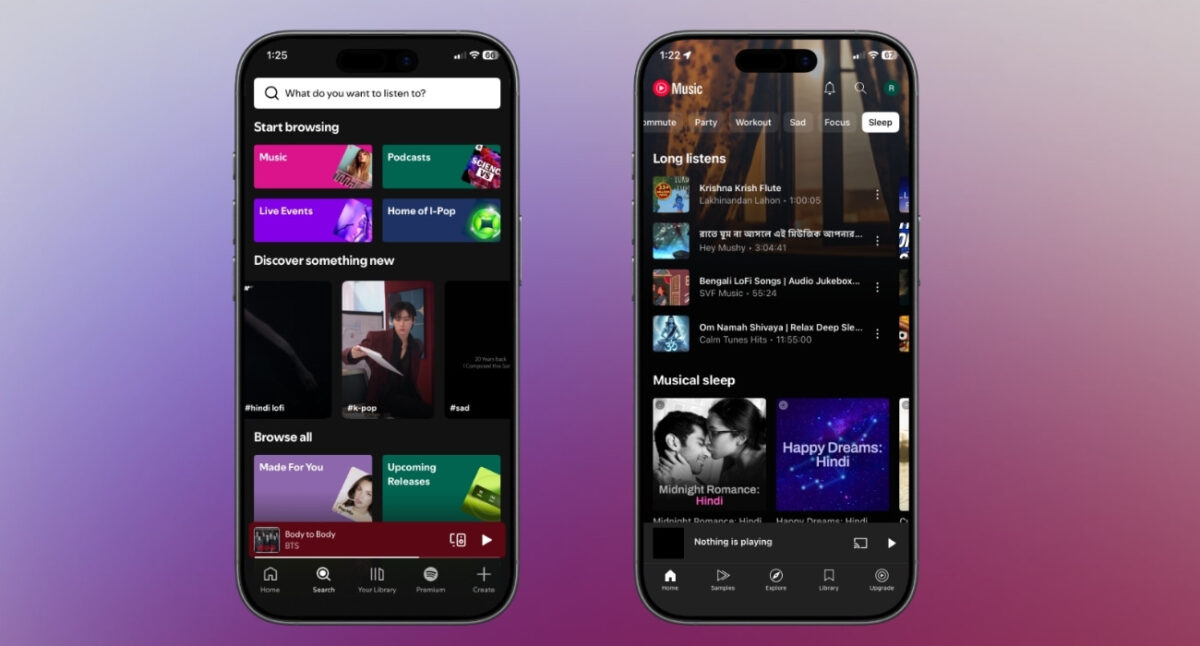
Spotify’s discovery is powered by a highly precise algorithm and AI curation from a 100 million track catalog. Discover Weekly, Release Radar, and Daily Mixes are sharp, accurate, and deeply personalized.
AI DJ transformed my listening experience totally. It allows you to enjoy a customized stream with commentary adjusted to your personal preferences. As a result, I discovered new music suggestions along with my favorite ones. Then there’s AI playlist generation by typing a prompt and getting a surprisingly accurate mix. However, there’s no fan-created content.
YouTube Music doesn’t have that level of AI sophistication. But it has something more chaotic and sometimes more valuable.
Because it taps into the full YouTube ecosystem, I kept finding:
If you only want to listen to licensed official tracks to support the artist, Spotify is the way to go.
Overall, Spotify feels like it understands you over time, whereas YouTube Music feels like it reacts to what you just played.
Spotify wins this, and it’s not close. Its curated playlists (like Daily Mixes and Discover Weekly) felt engineered with intent. Transitions are smooth, the vibe holds, and the skips are minimal. The tracks evolve constantly and somehow stay relevant. After two weeks, I stopped searching manually and just trusted the homepage.
YouTube Music playlists feel algorithmically assembled. Some playlists, such as Your Mix and My Supermix, are great, while others are just loosely formed. There were times when the same songs kept popping up. Once I stopped relying on playlists and started exploring manually, YouTube Music became more interesting.
Additionally, Spotify has a strong social layer, like shared playlists, collaborative editing, and easy sharing, which YouTube Music still lacks depth in.
Let’s be honest: most people won’t hear a massive difference.
Spotify allows higher bitrate streaming, up to 320 kbps, whereas YouTube Music usually has streams with a maximum of 256 kbps. Thus, on good headphones, I found sounds slightly cleaner, especially in high frequencies and layered tracks.
But in everyday listening, such as streaming in the car, gym, or casual use, the gap is negligible. If you want to experience immersive audio, go for Apple Music. It offers Dolby Atmos or high-res lossless quality.
What mattered more to me was consistency, and Spotify wins there. Fewer fluctuations, more stable playback across devices and networks. YouTube Music occasionally felt dependent on internet connection and source quality, especially when pulling from video-based content.
Spotify is just reliable. Downloads work exactly how you expect. Offline playback is seamless. Switching networks is invisible.
YouTube Music works great with the Offline Mixtape, which auto-downloads a 100-song playlist, and Smart Downloads. Moreover, you can upload up to 100,000 tracks to your private YouTube Music library from your computer. These tracks get synced across your devices and logged into the same Gmail.
If you travel or commute heavily, this matters more than you think.
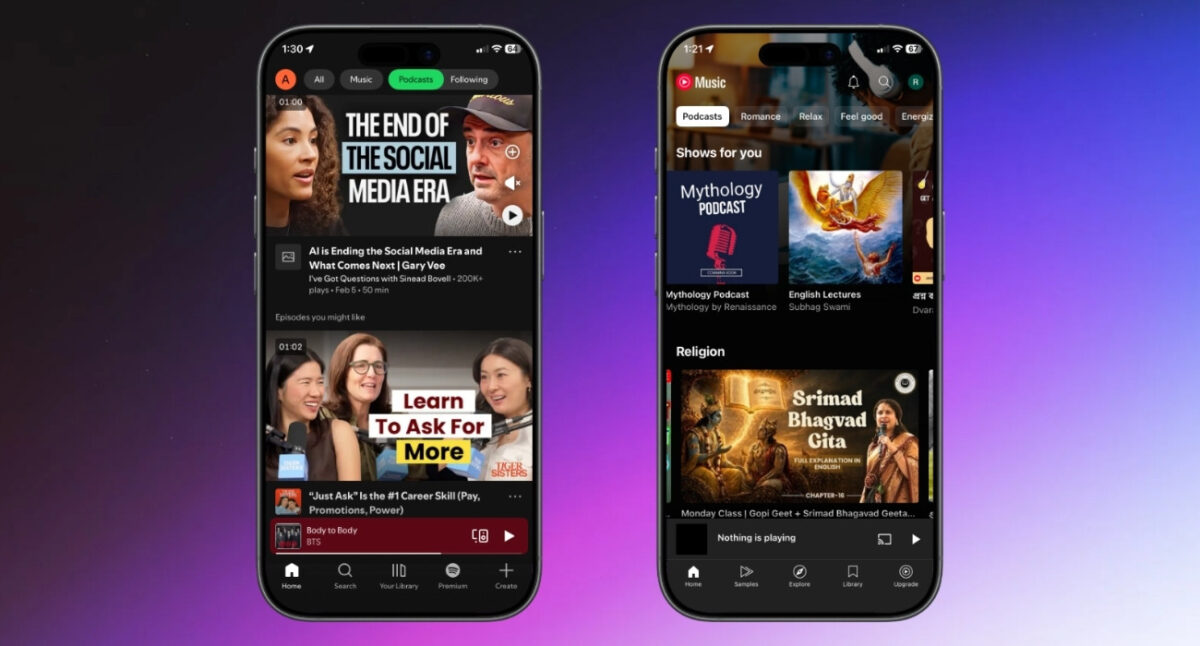
This is where Spotify quietly pulls ahead, and also risks losing focus.
That Peloton integration genuinely surprised me. I could start a workout class, follow guided audio/video, and stay inside Spotify the whole time. No need to switch apps.
But YouTube Music has something Spotify cannot replicate: The internet’s largest music archive. Also, there’s a growing number of podcasts and user-uploaded audiobooks.
Both platforms have a free tier with ads.
The Spotify free plan has limited ads and only shuffled music. You can’t download any song for offline listening or access Peloton classes. The good news with YouTube Music is that its free version provides unlimited skips and on-demand playback. However, you can’t play music in the background and save songs for offline.
For Premium subscription, pricing is basically identical: $10.99/month. But value isn’t.
Spotify gives you a premium, focused experience, with a growing list of features layered on top. So, if you care about a music-first experience, Spotify still feels worth it.
YouTube Music becomes a completely different deal if you already use YouTube heavily. If you buy YouTube Premium ($13.99/month), you’re not just paying for music; you’re removing ads across YouTube, unlocking background play, and getting access to everything in one ecosystem.
I started this experiment expecting a clear answer, but ended it with a split decision.
If I had to recommend one app to most people for music streaming, it’s Spotify. It’s smarter, more reliable. And now, with AI, fitness, and ecosystem expansion, it’s evolving into something much bigger than a music app.
But if you want to explore underrated music and song covers, watch music videos, create your own private library, or have automatic downloads, YouTube Music wins. Whenever I am in the mood for an unpredictable playlist rather than a loop of the same genre songs, it takes place.
The real winner depends on whether you want your music experience optimized or explored. What’s your take? Let me know in the comments below!
Must read: