FaceTime Like a Pro
Get our exclusive Ultimate FaceTime Guide 📚 — absolutely FREE when you sign up for our newsletter below.

FaceTime Like a Pro
Get our exclusive Ultimate FaceTime Guide 📚 — absolutely FREE when you sign up for our newsletter below.


Apple Watch shipments jumped 21% in Q1 2026, giving Apple 23% global share as health features and the SE 3 helped drive demand.
Apple Watch had a strong start to 2026. According to Counterpoint Research, global smartwatch shipments grew 4% year over year in Q1 2026, while Apple Watch shipments rose 21%.
That gave Apple a 23% share of global smartwatch shipments for the quarter. The important word is shipments, not sales. Apple does not disclose Apple Watch unit sales, so Counterpoint’s figures are third-party market estimates rather than Apple’s own numbers.
Apple’s growth was well ahead of the broader market, but it was not the only brand that grew. Huawei stayed in second place with 17% share, while Xiaomi and Imoo also posted smaller shipment gains. The chart makes the shift clear: Apple moved from 20% share in Q1 2025 to 23% in Q1 2026, while Samsung slipped from 7% to 5%.
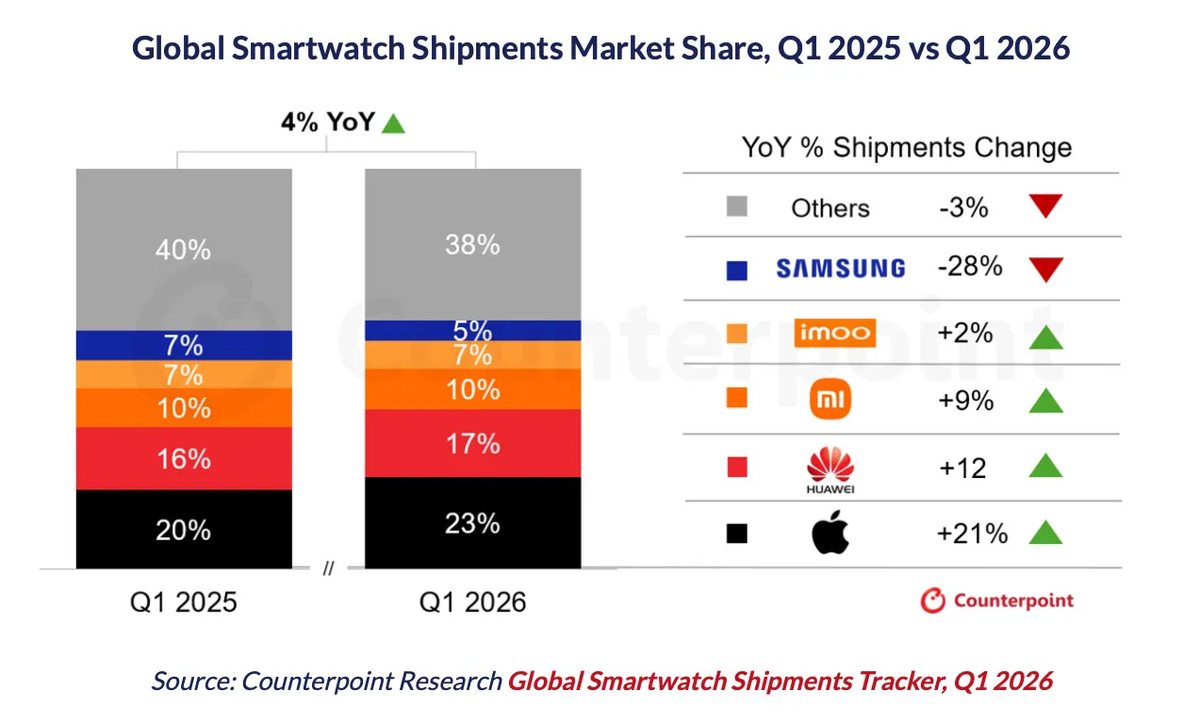
Samsung was the sharp contrast in the report. Its smartwatch shipments fell 28%, showing how uneven the recovery still is across the wearables market.
Counterpoint analyst Anshika Jain pointed to two reasons behind Apple’s growth: stronger health upgrades and the more affordable Apple Watch SE 3. North America still made up more than half of Apple’s shipments, while China and Europe were the fastest-growing regions for the brand.
That matches where Apple has been pushing the Watch for years. The product is less about being a tiny phone on your wrist and more about health, fitness, safety, and quick glanceable actions. Apple’s new watchOS 27 features continue that direction with more health APIs, smarter Siri hooks, better battery behavior, and more useful Smart Stack suggestions. The broader iOS 27 Health app update is moving in the same direction, with more tracking around nutrition and women’s health.
The timing is worth separating, though. Q1 ended before WWDC 2026, so watchOS 27 did not cause this shipment jump. The report is still a useful sign that Apple’s health-first watch strategy is working before the next software cycle reaches users.
Counterpoint also says smartwatch average selling prices rose 6% year over year in Q1 2026. Better sensors, health monitoring, AI features, and upgrades from basic to advanced smartwatches in markets such as India helped push prices up.
That matters for Apple because it already plays heavily in the premium smartwatch segment. If buyers keep moving toward more capable watches, Apple benefits even when cheaper fitness bands and basic watches remain popular.
The report expects memory shortages and broader economic pressure to slow smartwatch growth slightly in 2026. Still, Counterpoint says smartwatches should be less exposed than other consumer electronics categories because their parts costs are lower and premium models carry stronger margins.
For Apple, the bigger takeaway is simple: the Watch is still growing when the right mix of price, health features, and regional demand lines up. The SE 3 appears to be doing its job at the lower end, while higher-end models like the Apple Watch Ultra 3 keep Apple’s wearable story tied to health and everyday utility.