FaceTime Like a Pro
Get our exclusive Ultimate FaceTime Guide 📚 — absolutely FREE when you sign up for our newsletter below.

FaceTime Like a Pro
Get our exclusive Ultimate FaceTime Guide 📚 — absolutely FREE when you sign up for our newsletter below.


Google’s new speed model finishes tasks 2.5x faster than Gemini 3.8 Flash, costs developers $1.50 per million input tokens, and reaches free Gemini users through Auto.
Google launched Gemini 4 Hydrogen and calls it a fast, lower-cost model for everyday coding and agentic work. Agentic work means jobs where the AI takes several steps on its own to finish a task.
Google places Hydrogen beside Gemini 4 Carbon and Gemini 4 Argon, its most advanced models. Hydrogen has four thinking levels, from low to xhigh, and high is the default. Thinking levels control how hard the model works on a question before it answers.
Google says Hydrogen finishes tasks about 2.5 times faster than Gemini 3.8 Flash at its default high setting. If you ask many quick questions, that is the number that matters most.
Not everyone sees the speed gain. Theo (t3.gg) ran the same code review brief through Hydrogen and several rival models, then posted the results.
“Built for speed” Still garbage speeds compared to anything else on the market. Note that I ran Sol and Opus at regular tier! Didn’t even use fast/ultrafast. https://t.co/DWQ8pPExmP
— Theo – t3.gg (@theo) November 12, 2026
Theo’s chart puts Hydrogen at 4 minutes 43 seconds. Gemini 4 Carbon took 14 minutes 8 seconds, Opus 5.5 took 2 minutes 53 seconds, and GPT-6.1 Sol took 2 minutes 17 seconds. Each time is an average of four rounds. He says he ran Sol and Opus at their regular tier, not the fast or ultrafast modes.
That is one coding task, so it is one data point. It does not clash with Google’s 2.5x figure, which compares Hydrogen with Gemini 3.8 Flash, not with rival models. It does show that Hydrogen can beat Carbon and still trail Sol and Opus on this test.
On the Artificial Analysis Intelligence Index, an independent score that combines several tests, Hydrogen scores 51 at its default setting and 54 at xhigh. Argon scores 50. A one-point gap at the default setting is small, so the intelligence claim is weaker than the speed claim.
On Terminal-Bench 4.1, a test of AI agents working in a terminal, Hydrogen scores 57%. Gemini 3.8 Flash scores 18.2% on the same test. Google also says Hydrogen produces more than five times fewer fabricated claims, its term for made-up statements, than 3.8 Flash.
Unnamed partners in Google’s tests saw runs 2x to 2.8x faster, with 12% to 23% fewer tokens. Tokens are the chunks of text a model reads and writes, and they are what developers pay for.
These are Google’s own tests and unnamed partner tests. They show what Google measured, not how Hydrogen will handle your work.
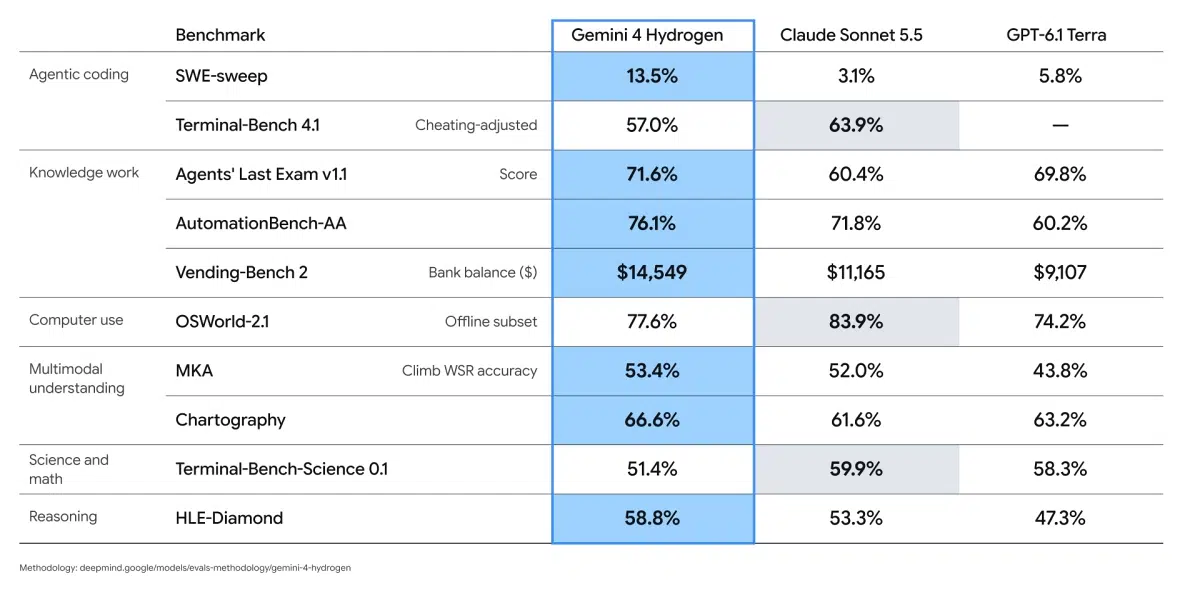
Hydrogen is in the Gemini app’s model picker, labeled “Everyday help.” Free users can’t pick it themselves. They reach it through Auto model selection when a prompt calls for it.
Free accounts lost access to Flash and Pro on October 9. For them, Auto is now the way to reach Hydrogen.
In Google’s Antigravity app, Hydrogen is limited to paid Google AI Pro and Ultra subscribers. Antigravity’s Orchestrator pairs Hydrogen with stronger models such as Carbon for longer tasks.
Gemini in Google Sheets starts with Pro and Ultra subscribers. Google says Hydrogen’s output there is more than 30% faster than earlier models.
Google says Hydrogen is rolling out in Search to all users worldwide.
Developers can use Hydrogen in Google AI Studio and the Gemini API on every tier. It costs $1.50 per million input tokens and $7.50 per million output tokens. Input is what you send the model, and output is what it writes back.
Output costs five times as much as input, so a long answer costs more than a prompt of the same length. The price stays flat across the full 1-million-token context window.
Google does not give a release date for each product. It says the rollout is gradual.
Before you switch an app to Hydrogen, run your own prompts through it and compare the speed and the bill with your current model.

As an Amazon Associate, iGeeksBlog earns from qualifying purchases.