
FaceTime Like a Pro
Get our exclusive Ultimate FaceTime Guide 📚 — absolutely FREE when you sign up for our newsletter below.

FaceTime Like a Pro
Get our exclusive Ultimate FaceTime Guide 📚 — absolutely FREE when you sign up for our newsletter below.


Google says Chrome has reached its highest-ever performance levels on Mac, with new benchmark results on the M5 MacBook Pro showing improvements in responsiveness, JavaScript execution, and WebAssembly performance.
 ByVikhyat
Google says the latest version of Chrome has reached record performance levels on the Mac, with new benchmark results showing notable gains on Apple’s M5 MacBook Pro.
The company shared the results on the Chromium Blog, highlighting improvements in web responsiveness, JavaScript execution, and WebAssembly performance.
The announcement comes as Apple continues to improve Safari on Apple silicon Macs, keeping competition between the two browsers intense on macOS.
Chrome achieved a Speedometer 3.1 score of 61 on an M5 MacBook Pro running macOS 26.0.1.
The result comes from Speedometer 3.1, an industry-standard benchmark designed to measure how responsive modern web applications feel during everyday use.
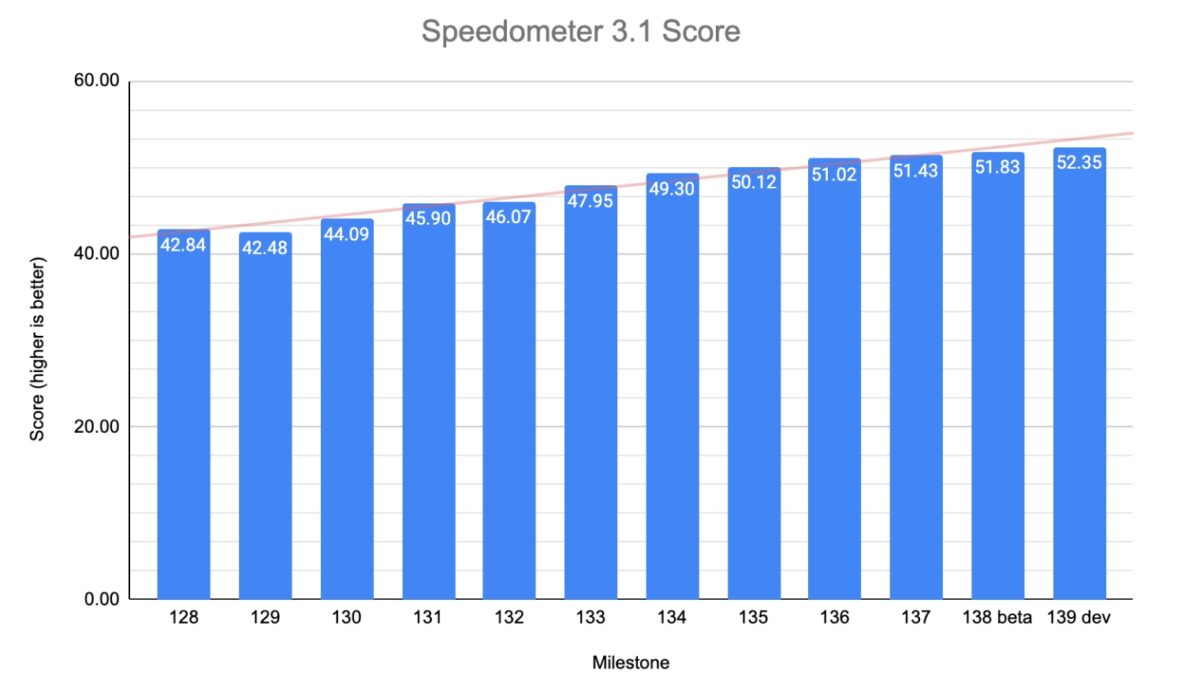
According to Google, the score is approximately 5% higher than the result it shared last year using an M4 MacBook Pro.
The benchmark evaluates a wide range of browser workloads, including HTML parsing, JavaScript execution, JSON processing, and rendering performance.
Google published similar benchmark results last year using an M4 MacBook Pro, making the latest figures a continuation of those earlier performance comparisons.
Google also shared results from JetStream 3, a benchmark focused on JavaScript and WebAssembly performance.
On the same M5 MacBook Pro running macOS 26.0.1, Chrome achieved a score of 469, which Google says is 10% higher than a comparable test conducted earlier this year.
According to BrowserBench, JetStream 3 is a benchmark suite designed to measure JavaScript and WebAssembly performance in advanced web applications.
As more apps increasingly rely on browser technologies, improvements in JavaScript and WebAssembly performance can help web apps feel faster, smoother, and more responsive.
The latest gains come from Google’s continued work on Chrome’s rendering engine, JavaScript execution, and WebAssembly optimizations.
Google attributes the improvements to optimizations across Chrome’s rendering engine, JavaScript execution pipeline, and WebAssembly performance. While benchmark gains do not always translate directly into identical real-world improvements, they remain one of the most widely used methods for measuring browser performance across platforms.
Have you noticed Chrome getting faster on your Mac? Let us know in the comments below.
You might also like: