FaceTime Like a Pro
Get our exclusive Ultimate FaceTime Guide 📚 — absolutely FREE when you sign up for our newsletter below.

FaceTime Like a Pro
Get our exclusive Ultimate FaceTime Guide 📚 — absolutely FREE when you sign up for our newsletter below.


Bloomberg says Apple's Home Hub (J490) will anchor the smart home as an intelligent center, with a square display, Siri AI OS, and employee testing underway ahead of a fall launch.
Apple’s long-rumored Home Hub will be the "intelligent center" of the home, the home equivalent of what the iPhone is for your pocket, according to Bloomberg.
Mark Gurman reports in his Power On newsletter that the device, codenamed J490, is now being tested widely inside Apple employees’ homes and will serve as the anchor for controls, video calls and media, tying together an "intelligent personal hub" strategy that CEO John Ternus laid out at the September 9 event.
Ternus called the iPhone the ideal intelligent personal hub for mobile life. Gurman says Apple wants a second hub for the household, a central place where Siri AI can pull personal context, device state and media together without asking you to dig out your phone in every room.
Gurman describes a roughly square display, about 7 inches, with thin bezels and rounded corners, smaller than an iPad mini and closer to an Amazon Echo Show in concept, but more restrained.
There are two expected forms: a tabletop version with the screen perched on a half-dome base that looks like a HomePod mini cut in half, and a wall-mounted version that attaches with magnets. Both run a new operating system built around Siri AI, previously reported as "Charismatic," that blends iOS, tvOS and watchOS ideas. It includes a home screen, widgets and clock faces, with StandBy-like glanceability on the iPhone Duo as a reference point. Setup syncs with an iPhone.
Facial recognition is part of personalization, but not Face ID as you know it. Gurman says the Hub identifies who is nearby with a standard camera rather than a TrueDepth sensor array, then tailors what it shows, calendar, photos, suggested media, to that person. If that approach works reliably in a kitchen-lighting reality, he notes it could even inform how Apple adds similar recognition to a future iPhone Duo without the depth-camera bulk. That’s reported possibility, not promise.
The Hub is being built for next-generation Siri AI, the personal-context assistant Apple has tied to App Intents and Private Cloud Compute. Gurman says on the Hub, Siri can surface information across your devices and accounts, find a podcast or song someone sent weeks ago, display a relevant photo, and carry out more precise tasks in Notes, Reminders and Calendar, plus run complex searches within Apple apps. That same Siri AI push is already rolling out with the iPhone 18 Pro, which gives a sense of what Apple wants the voice experience to feel like before the home hardware arrives.
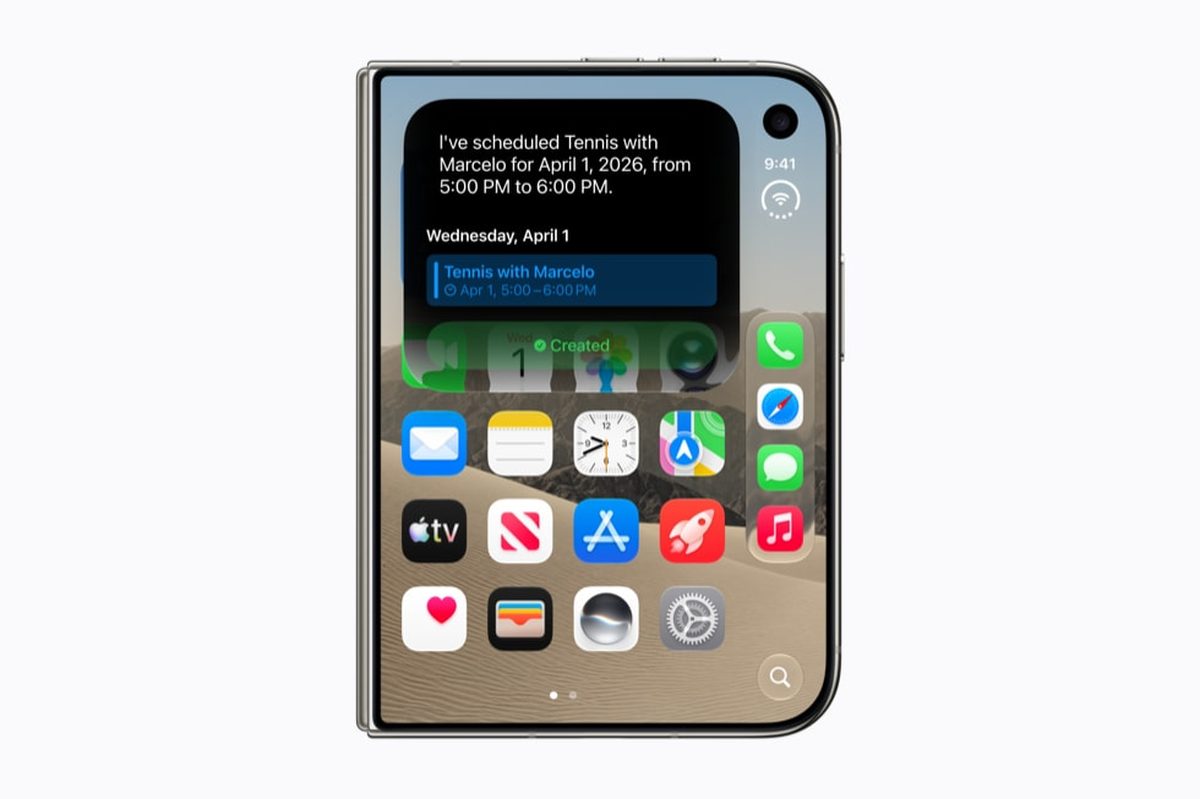
That Siri foundation is also why the product has slipped before. Gurman previously noted the Hub was originally planned for March 2025 and then pushed because the Siri features it needs, personal data reasoning and app control, weren’t ready for iOS 18.4. Those delays explain why a hardware-ready display sat in employee homes long before launch.
Gurman has not given a firm date, but the latest note places the Hub as one of the most anticipated launches of Ternus’s early tenure, alongside the iPhone Duo and a touch-screen MacBook. A summary of the same newsletter puts the window as early as next month, with broader reporting pointing to fall 2026.
Apple has not confirmed timing. Earlier background from Gurman still expects refreshed Apple TV and HomePod mini models with faster chips to support Siri AI around the same period, plus a more ambitious tabletop robot with a 9-inch arm-mounted display down the road. For now, the home Hub plus those living-room updates are the expected first wave.
If you already live with an iPhone, Apple Watch and HomePods in most rooms, Gurman suggests the Hub’s value will still come down to one question: can a fixed screen with better voice handle the home stuff faster than pulling a phone from your pocket? Apple thinks the answer is yes, provided Siri AI actually feels personal, not just vocal.