FaceTime Like a Pro
Get our exclusive Ultimate FaceTime Guide 📚 — absolutely FREE when you sign up for our newsletter below.

FaceTime Like a Pro
Get our exclusive Ultimate FaceTime Guide 📚 — absolutely FREE when you sign up for our newsletter below.


Uncover the magic of Apple's ProMotion Technology—smoother scrolling, better gaming, and smart battery savings. Here's what makes it special!

 ByParvez Mulla and Yash Wate
Ever noticed how buttery smooth scrolling feels on an iPhone Pro model?
That’s thanks to ProMotion, Apple’s advanced display technology that dynamically adjusts the screen’s refresh rate between 1Hz and 120Hz. Unlike traditional 60Hz displays, ProMotion increases smoothness and responsiveness when scrolling, gaming, or watching videos while lowering the refresh rate during static content to conserve battery life.
Apple first introduced ProMotion technology in 2017 with the iPad Pro (2nd generation). This was a significant leap in display performance, as it allowed the screen to refresh at up to 120Hz, providing ultra-smooth scrolling, fluid animations, and more responsive touch interactions.
Initially, ProMotion was exclusive to iPads, but Apple later brought it to the iPhone 13 Pro and iPhone 13 Pro Max in 2021, giving iPhones their first-ever adaptive refresh rate. This meant that the display could intelligently switch between 1Hz and 120Hz depending on the type of content displayed.
In 2021, Apple also added ProMotion to its MacBook Pro (14-inch and 16-inch models), enhancing the experience for professionals who rely on smooth visuals, such as video editors, designers, and gamers.
As of today, ProMotion remains a Pro-exclusive feature, available only on iPhone Pro models, high-end iPads, and MacBook Pro devices. Standard iPhone and iPad models still use traditional 60Hz displays, though there is speculation that Apple might extend ProMotion to more devices in the future.
Unlike standard high-refresh-rate screens that stay locked at 120Hz, ProMotion uses adaptive refresh rate technology. It detects the type of content on the screen and adjusts dynamically:
This balance between performance and efficiency is what makes ProMotion unique.
You can see the difference between a ProMotion and a non-ProMotion display in the video below.
Not necessarily! While higher refresh rates, like 120Hz, generally consume more power, Apple’s ProMotion display technology is designed to intelligently adapt and optimize refresh rates based on user activity. This ensures a balance between smooth performance and battery efficiency.
To understand this better, let’s first look at what refresh rate (Hz) means.
Hertz (Hz) refers to how many times per second a display refreshes the image on the screen. A standard 60Hz display refreshes 60 times per second, whereas a 120Hz display refreshes 120 times per second. This makes animations, scrolling, and interactions feel significantly smoother. However, constantly running at higher refresh rates can drain battery life faster.
That’s where ProMotion comes in! Instead of staying fixed at 120Hz, it dynamically adjusts the refresh rate based on what you’re doing:
By dynamically adjusting to your usage, ProMotion helps you experience buttery-smooth performance without excessive power consumption—giving you the best of both worlds!
| Feature | Standard 60Hz Display | ProMotion (1Hz-120Hz) |
| Smoothness | Basic scrolling | Super fluid scrolling |
| Gaming | 60 fps cap | Up to 120 fps |
| Battery Life | Fixed refresh rate | Adaptive to save power |
| Animations | Less responsive | Superfluid scrolling |
Not all Apple devices come with ProMotion. Here’s a list of supported models:
| Category | Model | ProMotion (up to 120Hz) |
|---|---|---|
| iPhone | iPhone 13 Pro / 13 Pro Max | ✅ Yes (first iPhones with it) |
| iPhone 14 Pro / 14 Pro Max | ✅ Yes | |
| iPhone 15 Pro / 15 Pro Max | ✅ Yes | |
| iPhone 16 Pro / 16 Pro Max | ✅ Yes | |
| iPhone 17 | ✅ Yes (first base model with it) | |
| iPhone Air | ✅ Yes | |
| iPhone 17 Pro / 17 Pro Max | ✅ Yes | |
| iPhone 13 to 16 and Plus models | ❌ No (60Hz) | |
| iPhone 16e / 17e | ❌ No (60Hz) | |
| iPhone 18e (rumored) | ❌ No (60Hz, according to leaks) | |
| iPad | iPad Pro (2017 and later, including M4 and M5) | ✅ Yes |
| iPad Air | ❌ No (60Hz) | |
| iPad (base model) | ❌ No (60Hz) | |
| iPad mini | ❌ No (60Hz) | |
| Mac | MacBook Pro 14″ and 16″ (2021 and later) | ✅ Yes |
| MacBook Air | ❌ No (60Hz) |
If you interact with the screen a lot and are afraid that it might increase battery usage, you can turn off ProMotion. Here’s how to do it on different Apple devices.
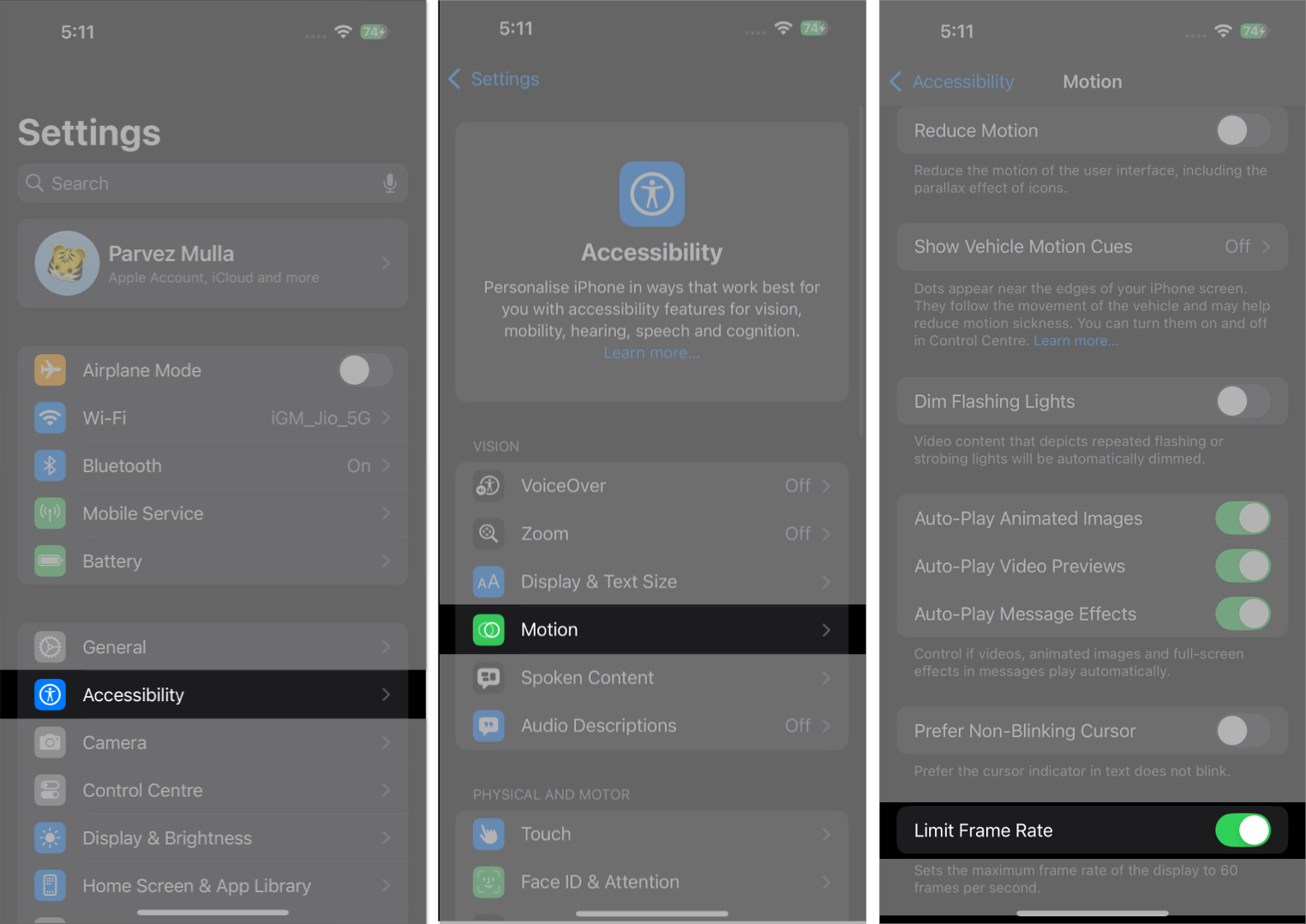
Now, your iPhone will limit the maximum frame rate to 60 Hz, saving battery life.
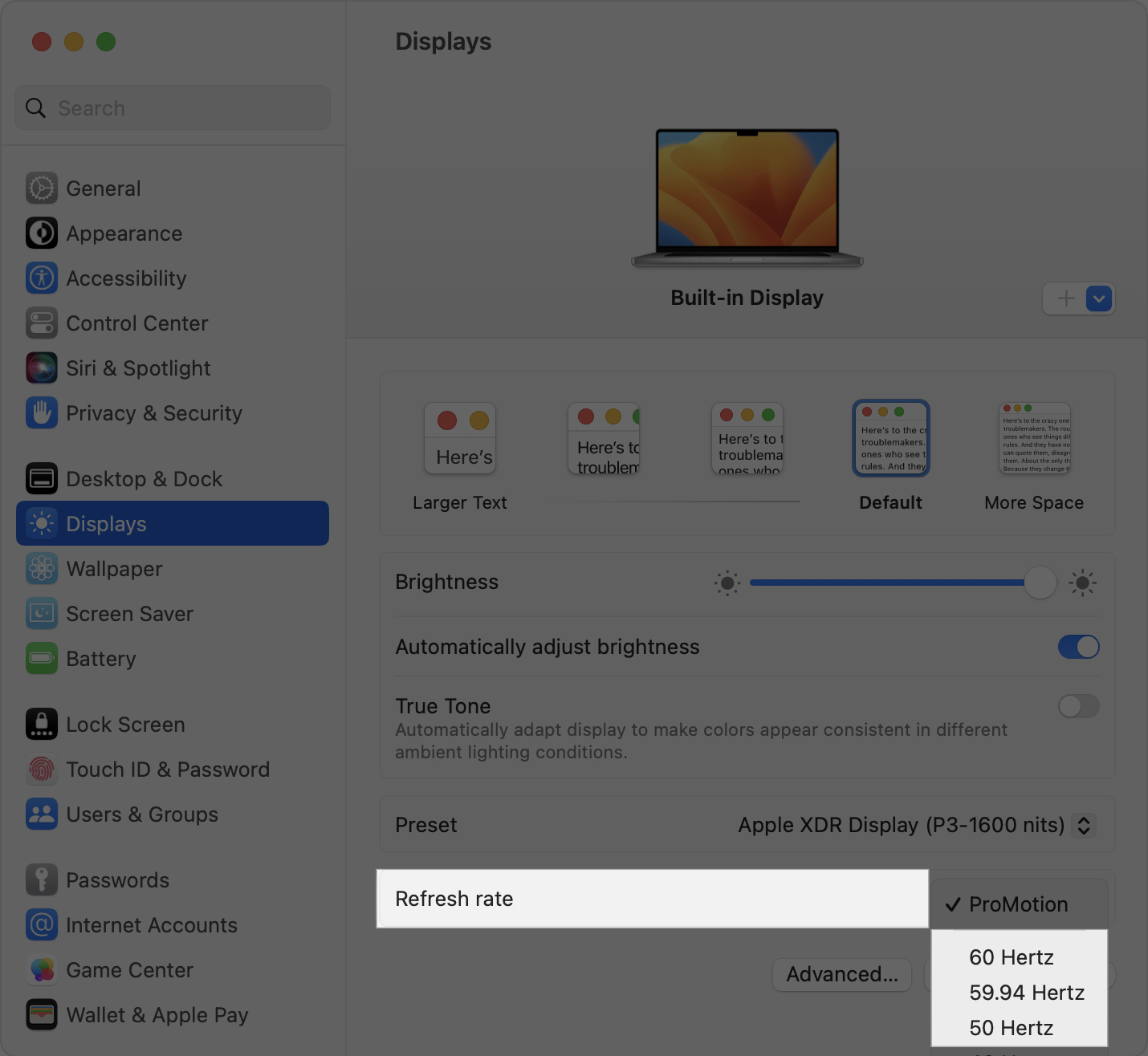
Apple strategically limits ProMotion to its Pro models for several key reasons:
Apple distinguishes Pro and non-Pro iPhones by offering high-end features like ProMotion, telephoto cameras, and premium build materials exclusively on Pro models. This encourages customers who want the best features to upgrade to higher-end iPhones.
ProMotion display requires advanced display hardware, such as LTPO (Low-Temperature Polycrystalline Oxide) panels, which increases manufacturing costs. By keeping it exclusive to Pro models, Apple reduces costs on base models and maintains a more affordable price point.
While ProMotion optimizes refresh rates dynamically, a higher refresh rate display still consumes more power than a fixed 60Hz display. Since non-Pro iPhones usually have smaller batteries and lack Pro-grade efficiency optimizations, Apple may have decided to keep them at 60Hz for better battery life.
By reserving ProMotion for Pro models, Apple creates a strong upsell incentive. Users who experience ProMotion’s smoothness on a Pro model are more likely to stay within the Pro lineup when upgrading, increasing Apple’s long-term revenue.
If you’re wondering whether ProMotion is a game-changer for your daily usage, here’s a quick guide:
Upgrade if you:
Skip if you:
ProMotion display is a huge leap in display technology, offering a perfect balance between smoothness and efficiency. If you prioritize fluid animations, gaming, or an immersive experience, upgrading to a ProMotion-supported device is definitely worth it.
You might also like: