FaceTime Like a Pro
Get our exclusive Ultimate FaceTime Guide 📚 — absolutely FREE when you sign up for our newsletter below.

FaceTime Like a Pro
Get our exclusive Ultimate FaceTime Guide 📚 — absolutely FREE when you sign up for our newsletter below.


Spotify’s new Verified badge helps confirm whether music comes from real artists or AI. Here’s how it works and why it changes how you listen.
Spotify has started rolling out a new Verified by Spotify badge designed to confirm that an artist is authentic, not an AI persona. The move comes at a time when AI-generated tracks are rapidly scaling across streaming services, making it harder for listeners to distinguish between real artists and algorithmically produced content.
With this update, Spotify is signaling that authenticity needs to be verified. I didn’t expect this to affect me much. But the first time I noticed that badge while listening, it changed how I interpreted the music instantly. Here’s everything you need to know about the Verified by Spotify badge.
Spotify’s new Verified by Spotify badge is a green checkmark that appears on certain artist profiles and in search results. It signals that an artist has been reviewed and meets Spotify’s standards for authenticity.
However, this is what happened because of some reasons. AI music didn’t just arrive; it flooded the system. In the past few years, I’ve personally noticed many playlists being loaded with songs that are perfectly mixed but lack emotional depth and are very forgettable.
And that created a real problem:
Spotify had two options: ignore it or rebuild trust. And this badge is their answer. It’s not about banning AI music. It’s about giving listeners a way to separate signal from noise.
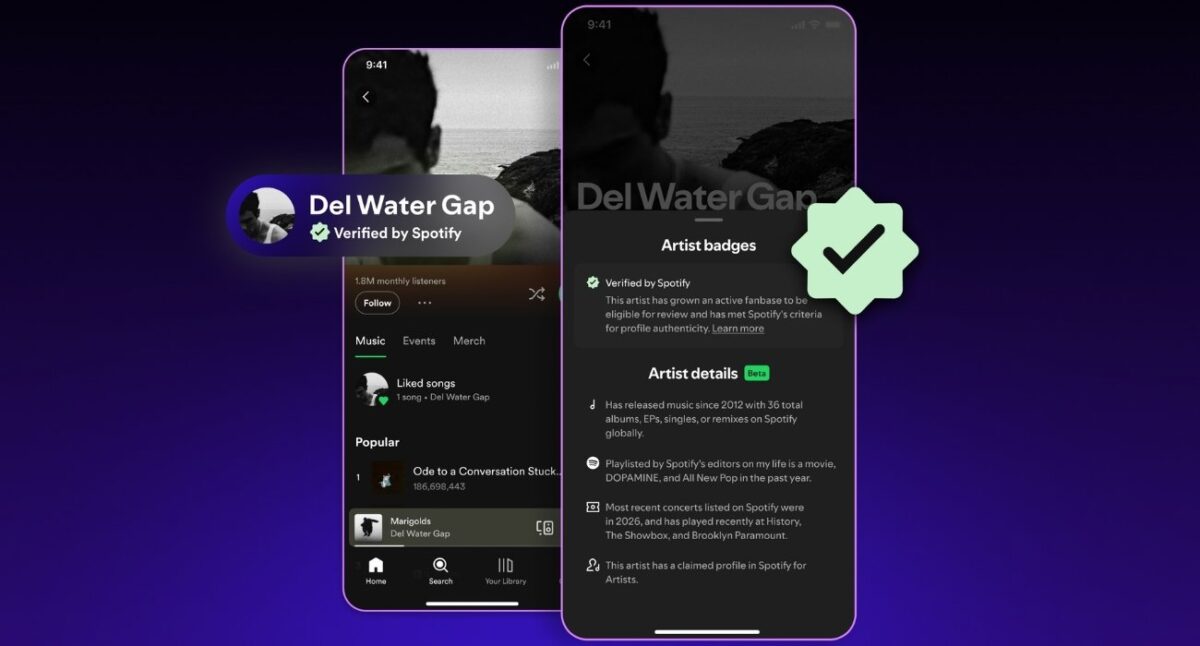
What I found interesting is that Spotify isn’t doing a simple ID check; it’s using a multi-signal trust system.
To qualify for the Verified by Spotify badge, artists need consistent listener activity over time, not just sudden spikes. Spotify also looks for a real-world presence, like social media activity, audience engagement, live performances and merch.
On top of that, there’s behavioral analysis. Real artists tend to release music gradually, while AI-driven profiles often upload in bulk. As per BBC reports, the verification process would prioritize artists with “important contributions to music culture and history”, rather than “content farms.”
Two newer layers make this stronger. Firstly, it has introduced a new beta feature – Artist Profile Protections, which aims at preventing impersonations and fake accounts. Also, you will see expanded artist detail sections that highlight milestones, activity, and context.
All these updates build on song-level transparency features like SongDNA, expanded credits, About the Song details, and AI credits. So, you can have a deeper insight into the music and who actually made it. And importantly, Spotify combines automated systems with actual human review.
The badge also appears when you search for the verified artist.
Globally recognized musicians and mid-tier artists with massive fanbases, consistent streams, and real-world presence have already gained the badges in the initial rollout.
You can see it for:
In the coming weeks, more artists will have the badge as per Spotify.
Additionally, you can find the verification badge for popular podcasts like The Joe Rogan Experience, Smartless or Good Hang with Amy Poehler.
I’ll be honest, this system is useful, but it’s far from flawless.
Similarly, Apple Music also launched Transparency Tags for new music to identify AI content.
This is where things start to ripple out.
For artists, it’s no longer enough to just upload music. You need to exist as an artist.
That means they need to:
In a way, Spotify is pushing artists toward being more humanly visible.
For listeners, the shift is more subtle, but just as important. We’re moving from passive consumption to active evaluation. Ironically enough, it did not change my perception regarding music.
Spotify is making authenticity visible and identity a part of the listening experience. And the Verified by Spotify badge is just the first step. I wouldn’t be surprised if we soon see AI disclosure labels on tracks, verification tiers for artists, and even filters to separate AI and human-made music.
What do you think about this rollout? Let me know in the comments below!
You may like to read Spotify’s New AI Chatbot Features.