FaceTime Like a Pro
Get our exclusive Ultimate FaceTime Guide 📚 — absolutely FREE when you sign up for our newsletter below.

FaceTime Like a Pro
Get our exclusive Ultimate FaceTime Guide 📚 — absolutely FREE when you sign up for our newsletter below.


Apple Intelligence is powered by five specialized Foundation Models that handle language, images, reasoning, dictation, and multimodal AI. Here's how Apple's new AI architecture works.
 ByVikhyat
Apple’s AI architecture looks very different in 2026. Instead of relying on a single foundation model for every Apple Intelligence feature, the company now uses five specialized models that handle language generation, image creation, multimodal understanding, dictation, and advanced reasoning.
The shift affects nearly every Apple Intelligence feature available across the iPhone, iPad, Mac, Apple Watch, and Vision Pro.
Two models run entirely on Apple devices, two operate through Private Cloud Compute, and one runs on NVIDIA GPUs hosted in Google Cloud. Apple says this approach allows each model to focus on a specific type of task while balancing performance, efficiency, and privacy.
Here’s a closer look at the five models powering Apple Intelligence and what each one brings to Apple’s AI ecosystem.
The architecture behind Apple Intelligence has evolved significantly over the past two years.
Initially, Apple offered a small language model that ran directly on devices alongside a more powerful cloud-based model powered by Private Cloud Compute.
Private Cloud Compute was designed to handle advanced AI requests using Apple-owned servers equipped with Apple silicon. The system extends Apple’s privacy protections to cloud-based AI processing, and Apple has even opened parts of the platform to independent security audits to validate those privacy claims.
At WWDC 2026, Apple expanded that strategy by introducing Google Gemini as part of its broader AI architecture alongside its own Foundation Models.
Rather than using a single model for every Apple Intelligence feature, Apple distributes responsibilities across five different AI models.
| Foundation Model | Primary Role | Runs On |
|---|---|---|
| AFM 3 Core | Everyday Apple Intelligence tasks | On device |
| AFM 3 Core Advanced | Multimodal AI and dictation | On device |
| AFM 3 Cloud | General cloud requests | Private Cloud Compute |
| ADM 3 Cloud (Image) | Image generation and editing | Private Cloud Compute |
| AFM 3 Cloud Pro | Advanced reasoning and agentic tasks | Google Cloud (NVIDIA GPUs) |
AFM 3 Core powers many of the everyday Apple Intelligence features that run entirely on your device.
Built on a 3-billion-parameter architecture, the model is optimized for speed, efficiency, and privacy. Because requests remain local, users benefit from fast responses without sending data to external servers.
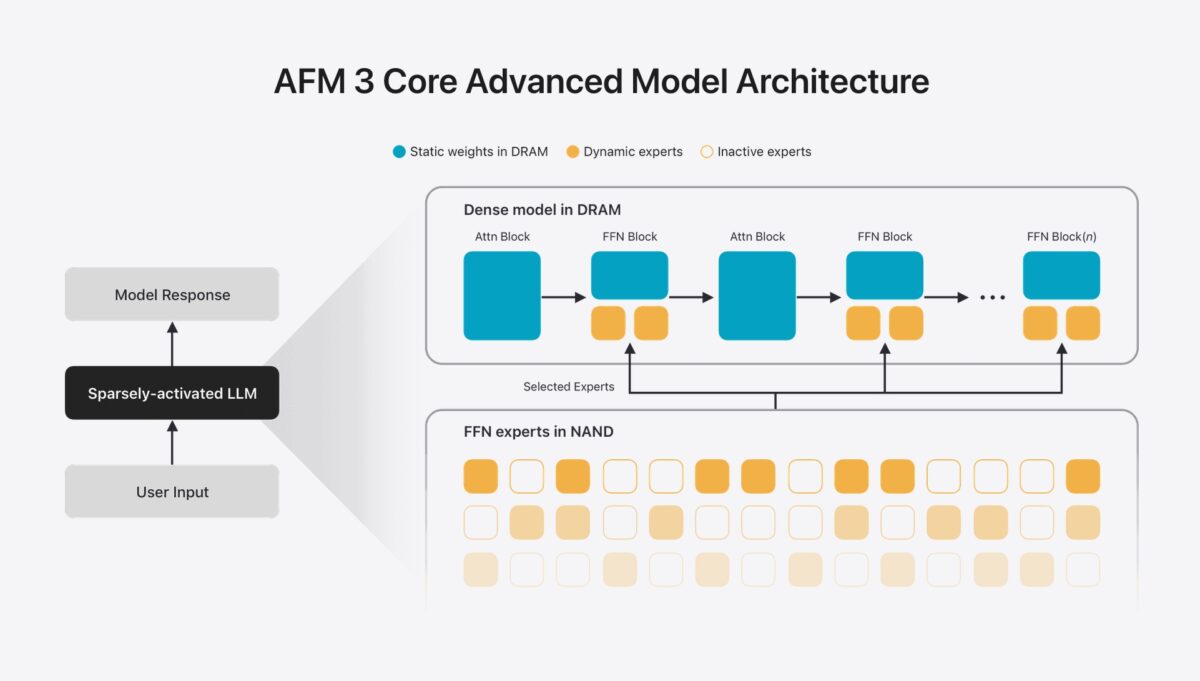
The biggest upgrade in Apple’s on-device AI lineup is AFM 3 Core Advanced.
This model uses a mixture-of-experts architecture rather than a traditional dense model. Although it contains 20 billion parameters, only around 1 to 4 billion are activated for any individual request.
By activating only a small portion of the model at a time, Apple can deliver stronger multimodal capabilities while maintaining efficiency and battery life.
The model powers advanced dictation, image understanding, and more sophisticated natural language tasks.
Not every AI request can be handled locally. AFM 3 Cloud serves as Apple Intelligence’s primary cloud-based model and runs entirely within Apple’s Private Cloud Compute infrastructure.
It handles larger requests that require more processing power while maintaining the same privacy-focused architecture Apple uses throughout its ecosystem.
Image generation now has its own dedicated AI model.
ADM 3 Cloud (Image) uses diffusion-based technology to power features such as Image Playground and image editing tools.
Separating image generation from language models allows Apple to optimize visual workloads independently while improving overall efficiency.
AFM 3 Cloud Pro sits at the top of Apple’s AI stack.
The model is reserved for the most demanding workloads, including advanced reasoning, agentic workflows, and complex multi-step tasks.
Unlike the rest of Apple’s AI infrastructure, AFM 3 Cloud Pro runs on NVIDIA GPUs hosted within Google Cloud.
This marks the first time an Apple Foundation Model operates outside Apple-owned infrastructure while still remaining part of the broader Apple Intelligence ecosystem.
Private Cloud Compute is no longer limited to Apple’s own servers.
Apple says it worked closely with Google to extend its privacy architecture to Google Cloud while maintaining the same security guarantees.
The system combines:
According to Apple, these safeguards allow complex AI requests to run on external infrastructure without compromising user privacy.
All five Foundation Models began with the same base training process before being specialized for different workloads.
Training data includes:
Apple says user data and user interactions were not used during training.
The company also allows publishers to opt out of future Foundation Model training datasets.
Apple evaluated its third-generation models using human reviewers across multiple categories, including:
According to Apple, both AFM 3 Core and AFM 3 Cloud outperform previous-generation models across a variety of text-based tasks and supported languages.
The company also reports major improvements in image understanding and says AFM 3 Core Advanced achieved higher preference ratings than Apple’s existing production dictation system across every evaluated category.
Apple’s AI strategy now relies on five specialized Foundation Models rather than a single large system.
Each model is optimized for a specific workload, allowing Apple Intelligence features to run more efficiently across different devices, services, and cloud environments.
From on-device language processing to cloud-based reasoning and dedicated image generation, Apple has built a far more modular AI architecture than it had just a few years ago.
As Apple Intelligence continues to expand, these five Foundation Models will serve as the backbone of nearly every AI-powered feature across Apple’s ecosystem.
Which part of Apple’s new AI architecture do you find most interesting? Let us know in the comments.