FaceTime Like a Pro
Get our exclusive Ultimate FaceTime Guide 📚 — absolutely FREE when you sign up for our newsletter below.

FaceTime Like a Pro
Get our exclusive Ultimate FaceTime Guide 📚 — absolutely FREE when you sign up for our newsletter below.


ChatGPT finally feels at home in Siri, but a few frustrating quirks keep it from replacing the standalone app.
Apple has finally made Siri feel less like a voice assistant and more like a proper AI chatbot. In iOS 27, iPadOS 27, and macOS 27, the new Siri AI app offers a conversational interface that will feel surprisingly familiar if you already use ChatGPT, Claude, or Grok.
The exciting thing is that although Siri is powered by Google’s Gemini model behind the scenes, you can switch to ChatGPT as an alternative AI provider. I spent some time asking ChatGPT, instead of Siri, on my iPhone in the new app. Here’s how the feature works, what it’s like to use, and whether it’s actually worth replacing the ChatGPT app.
The biggest change isn’t simply that Siri got smarter. Apple has turned Siri into an app.
With iOS 27, iPadOS 27, and macOS 27, you get a dedicated Siri AI experience that looks and behaves much more like a conventional AI chatbot. You can start conversations, type questions, use your voice, and return to previous Siri conversations later. Apple also syncs Siri conversations across devices through iCloud.
That makes the old Siri-versus-ChatGPT relationship considerably more interesting.
Previously, ChatGPT was essentially Siri’s backup plan. Whenever I asked a complicated question that Siri couldn’t answer, it would ask for my permission to send the request to ChatGPT. You could also explicitly prompt Siri to use ChatGPT to answer questions, create images, explain what’s on your screen, and more.
The new Siri app flips that experience around. Instead of waiting for Siri to decide that a question is too complicated, you can choose ChatGPT yourself. That’s the part I like most. If I want ChatGPT to handle something where I prefer its style or capabilities over Gemini-powered Siri, I can explicitly select ChatGPT.
Getting ChatGPT working inside the new Siri app is surprisingly straightforward.
Before starting, make sure you have a compatible iPhone or iPad running iOS 27 or iPadOS 27 and that you’ve already set up the new Siri AI experience by going to Settings > Siri > and tapping Try New Siri.
Note: iOS 27 and iPadOS 27 are currently in beta, so the interface may change before the final release.
Once you’re ready:
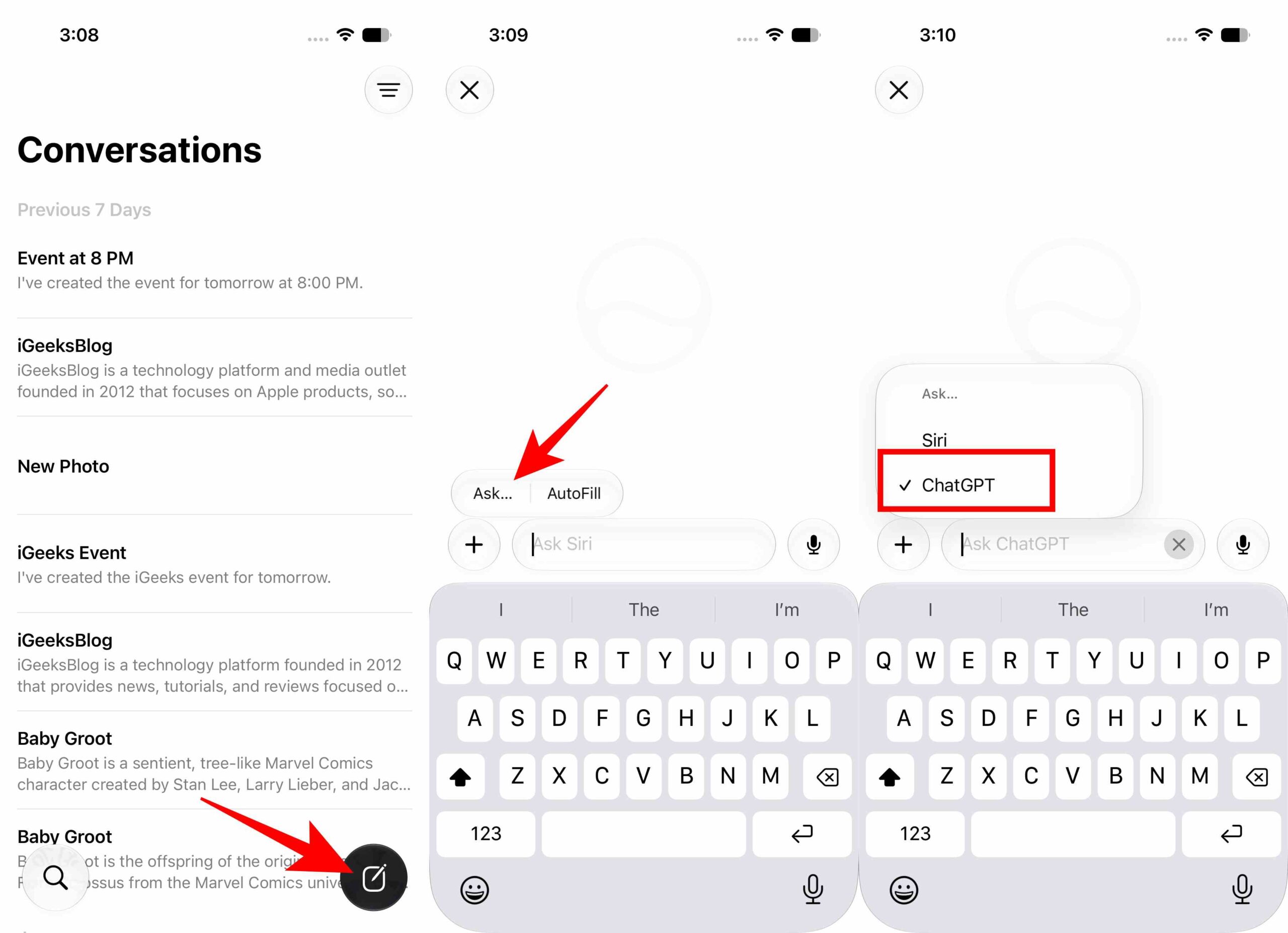
That’s how you know OpenAI is now handling your questions instead of Siri. From there, simply type your prompt or ask your question.
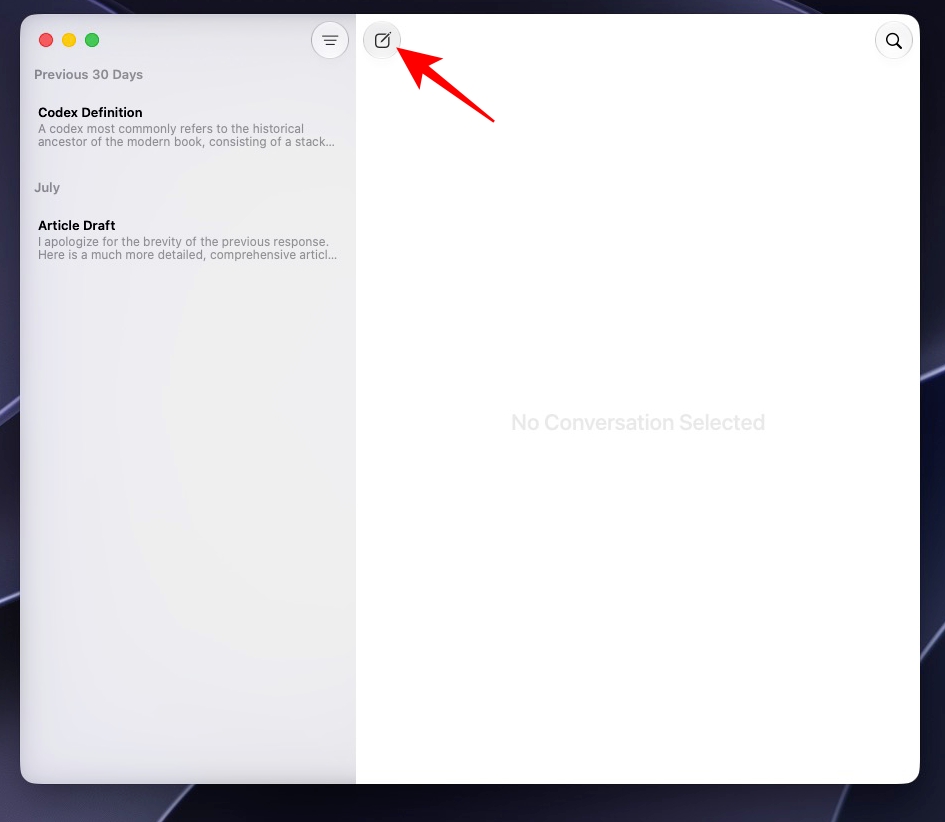
The process is almost identical on Mac, although the interaction is slightly different.
On a Mac running macOS 27 Golden Gate:
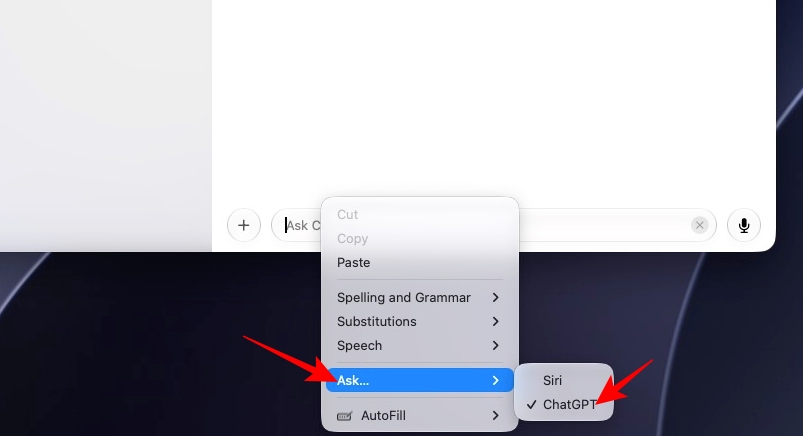
The input field changes to Ask ChatGPT, confirming that ChatGPT is now handling the conversation.
I like the consistency here. Apple hasn’t created a completely different workflow for Mac users. The basic idea remains the same: open Siri, choose the AI assistant you want, and start chatting.
This is where using the feature becomes more interesting. Siri and ChatGPT don’t behave like two completely separate apps. They can take turns handling the same conversational space.
During my testing, I found that after switching to ChatGPT, asking “Who are you?” results in an answer stating that ChatGPT is assisting me. Then, saying “Is it the Siri app?” surprisingly shifts the conversation from ChatGPT back to Siri. That’s a neat trick because it makes the experience feel fluid. You aren’t necessarily locked into one AI for the entire conversation.
But the reverse behavior is much less elegant. If you ask Siri to “Switch to ChatGPT,” it doesn’t simply change the provider inside the Siri conversation. Instead, it opened the standalone ChatGPT app on my iPhone as it was already installed.
That’s exactly the kind of inconsistency that makes me think this feature still needs some polishing. Apple has created a menu for choosing ChatGPT, so I would rather see that choice work consistently in both directions.
This is the biggest problem I found. ChatGPT is not a permanent setting in the new Siri app. You can select it to use it. But then Siri quietly forgets your preference.
In my testing, the app switches back to Siri when you:
There is currently no setting that lets you permanently set ChatGPT as the default AI provider in the Siri app.
And honestly, this is the part I would want Apple to change first. If I deliberately choose ChatGPT, there’s a good chance I chose it because I want ChatGPT to handle my next questions too. Making me select it again every time isn’t a major inconvenience, but it is unnecessary friction.
This limitation surprised me even more. You might reasonably assume that signing into your OpenAI account would make conversations started with ChatGPT inside Siri appear in your normal ChatGPT history.
They don’t. Any questions I ask through ChatGPT in the Siri app don’t appear in my ChatGPT account history, even after signing in to my OpenAI account through the device’s Siri and ChatGPT settings.
That’s important because it creates two separate ChatGPT experiences.
There’s:
They may both be powered by OpenAI, but your conversation history isn’t treated the same way.
For me, this makes the Siri integration much less compelling for anything I expect to revisit later. If I’m researching something, brainstorming an article, working on a project, or asking a question whose answer I’ll need tomorrow, I’d rather use the ChatGPT app.
If you don’t see ChatGPT as an option inside the Siri app, don’t assume the feature is broken.
The first thing to check is that the ChatGPT extension is enabled for Siri.
On iPhone, iPad, or Mac:
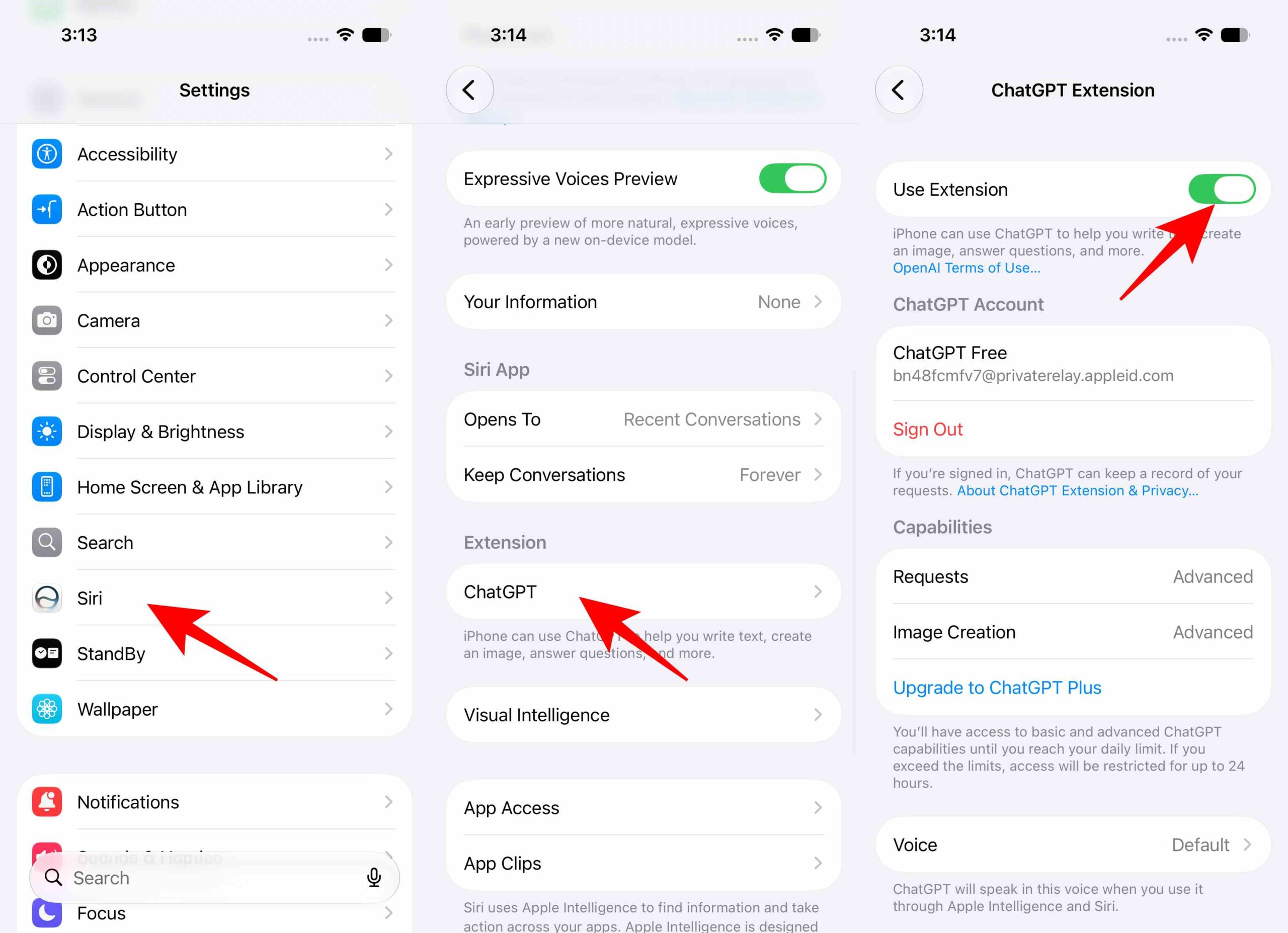
If it still doesn’t work, quit the Siri app and reopen it. As a final resort, restart the device and try again.
It’s worth remembering that we’re dealing with beta software here. Apple is still refining iOS 27, iPadOS 27, and macOS 27, so odd behavior shouldn’t necessarily be treated as a permanent limitation.
No. Not for me.
And I don’t think that’s necessarily a bad thing. ChatGPT inside Siri is useful precisely because it gives you another AI option without forcing you to leave Apple’s Siri environment.
But the dedicated ChatGPT app is still the better choice if ChatGPT is your primary AI assistant.
Here’s how I see it.
For quick questions, Siri’s implementation is genuinely convenient.
For serious ChatGPT use, I’ll still open ChatGPT.
ChatGPT isn’t necessarily the only third-party AI service that could eventually appear inside Siri.
Industry leaks have suggested Apple is open to giving other AI services a similar level of integration, with names such as Claude and Grok being obvious possibilities. The exact plans aren’t confirmed, so this should be treated as a possibility rather than a promised feature.
If Apple actually opens Siri to multiple AI providers, I think the current ChatGPT integration starts to make much more sense.
Imagine opening Siri and choosing:
That would turn Siri into something more interesting than another chatbot. It could become the front door to multiple AI assistants.
I like ChatGPT inside the new Siri app. I just don’t love the way Apple has implemented it.
For the first time, I can open Siri, decide that I want ChatGPT, and have OpenAI handle the question without treating ChatGPT as some emergency backup Siri calls when it gets stuck. That’s a meaningful improvement over the old Siri-to-ChatGPT experience.
But every new conversation effectively sends me back to Siri, so I have to choose ChatGPT again, and the conversations don’t appear in my normal ChatGPT history. That makes the Siri version feel temporary. It’s great for asking something and moving on, but less appealing when I’m doing work I want to keep.
Will you use ChatGPT inside the Siri app? Let me know your thoughts in the comments below!
Must Read: